Victorian Taxidermy: The Golden Age of Glass Cases and Curiosities
Walk into a Victorian parlor, or a museum's Victorian collection display, and you'll encounter a world of preserved creatures arranged in glass-fronted cabinets. Squirrels boxing with tiny gloves. Mice playing cards around miniature tables. Birds frozen mid-flight in dioramic settings. Rabbits arranged as a classroom with a larger rabbit as "teacher." It's a collision of art, natural history, taxidermy mastery, and something profoundly strange that feels simultaneously charming and utterly alien to modern sensibilities.
Yet this fascination wasn't frivolous or merely whimsical. It represented a specific cultural moment when middle-class Victorians, newly industrialized and increasingly urbanized, wanted to own nature, understand it, and display it as proof of their cultivation and wealth. The Victorian era unleashed an explosion of taxidermy creativity, dioramas, anthropomorphic scenes, naturalistic displays, and technical innovation, that fundamentally shaped how taxidermy evolved as both craft and art form. The period transformed taxidermy from museum work into a prestigious profession and cultural obsession.
The 1851 Great Exhibition: Taxidermy's Cultural Inflection Point
The turning point came in 1851 when London's Great Exhibition opened at the Crystal Palace. Among the thousands of exhibits showcasing industrial and artistic achievement was taxidermist John Hancock's masterwork: The Struggle with the Quarry, a dramatic diorama featuring a golden eagle locked in combat with a grouse, wings spread, muscles taut, the dynamic tension of the moment perfectly captured.
The response was electric and transformative. Victorians flocked to see it. Critics praised it. Artists studied it. The piece captivated public imagination and fundamentally changed how taxidermy was perceived. Suddenly, taxidermy wasn't just museum work or naturalist documentation, it was fine art. It was spectacle. It was something every affluent household wanted to own.
The market response was explosive: By 1891, just forty years later, London had 369 professional taxidermists. Every large village had a resident taxidermist. Middle-class families without grand country estates or hunting traditions still wanted mounted animals. The profession had transformed from specialized museum work to a common middle-class commodity. The trade didn't just grow; it exploded into a full professional industry.
The Victorian Specimen Cabinet: How the Wealthy Displayed Their Cultivation and Status
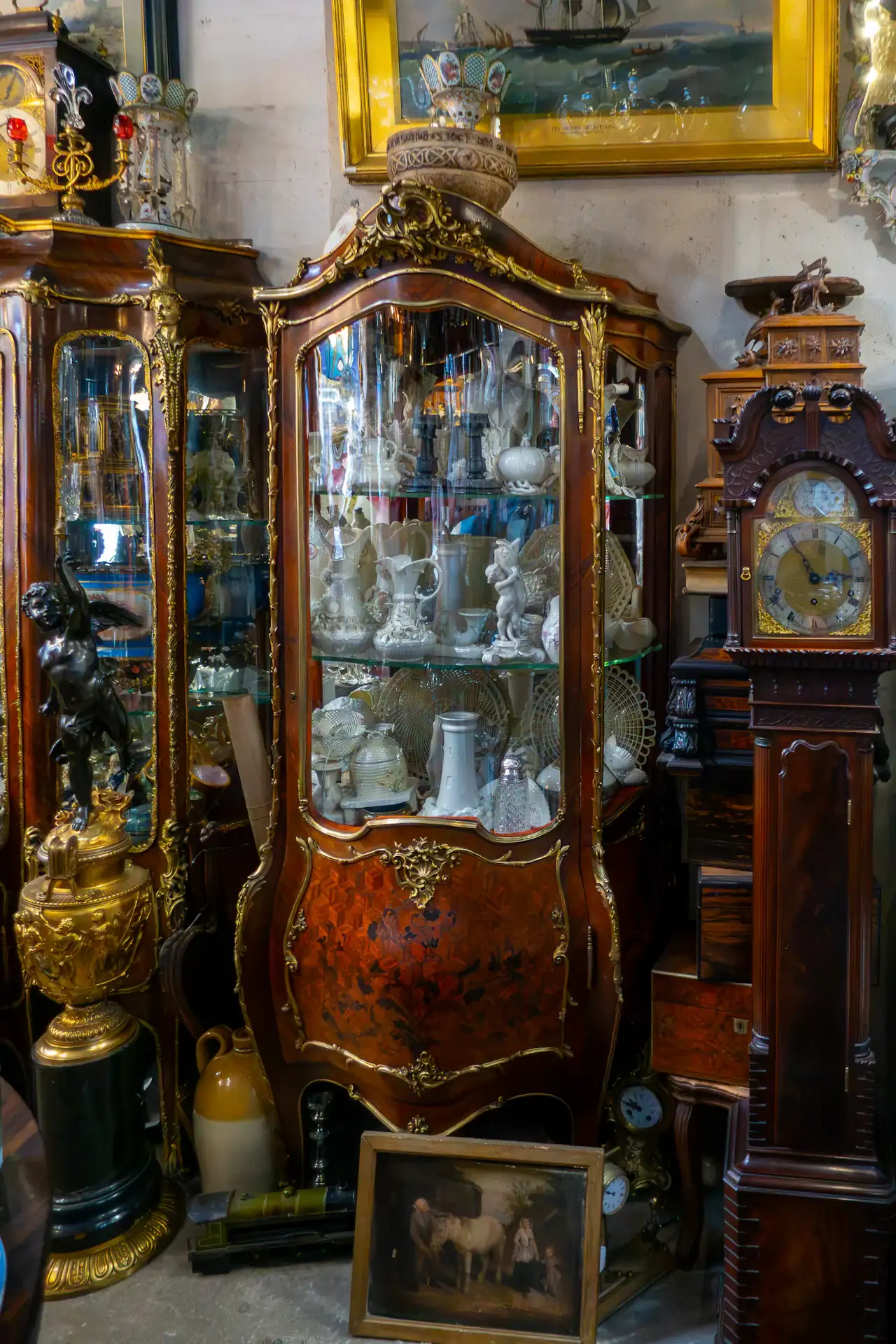
What Was Inside a Victorian Specimen Cabinet?
A typical Victorian specimen cabinet, called a "naturalist's cabinet," "curiosity cabinet," or "display cabinet", contained a carefully curated mix of items:
- Native species: Squirrels, foxes, rabbits, hedgehogs, songbirds, badgers, stoats, and other common British wildlife
- Exotic imports: Tropical birds, snakes, insects, and unusual specimens from colonial expeditions
- Taxidermied arrangements: Groups of animals posed in scenes (often anthropomorphic, animals doing human activities)
- Supporting naturalia: Minerals, fossils, skeletons, bird eggs, insects in frames, geological specimens
- Comparative specimens: Multiple individuals of the same species showing age/sex variation
These cabinets occupied visible positions, parlors, studies, drawing rooms, where guests could see them. They were public displays of the owner's wealth, taste, education, and connection to the natural world. The cabinet was a status symbol in its physical presence and content.
The Victorian Cabinet Aesthetic: Design and Display Philosophy
Physical design:
- Mahogany or walnut wooden frames (expensive, prestigious materials)
- Beveled glass fronts and sides (protection and premium aesthetic)
- Velvet or baize backing in deep colors, dark blue, deep red, burgundy (creating contrast and framing specimens)
- Tiered shelving or compartments for organizing specimens by size and category
- Often floor-standing (impressive height) or wall-mounted (space-efficient)
- Brass fittings, ornamental corners, and decorative details (reflecting the owner's investment)
Display philosophy:
- Density was aesthetic: Cabinets were packed with specimens, not spaced out. Empty space meant wasted opportunity and implied lack of collection wealth
- Scale hierarchy: Larger animals dominated eye level; smaller specimens filled upper and lower shelves
- Focal point placement: Rarest or most impressive animals placed centrally as visual anchors
- Grouping logic: Similar species grouped together to demonstrate variety and the collector's knowledge
- Narrative arrangement: Sometimes arranged to tell stories or show behaviors
- Color coordination: Arrangement considered overall color harmony and visual balance
This aesthetic endures today. Museum dioramas, natural history displays, and even modern cabinet design owe their visual language to Victorian specimen cabinet traditions. The dense, carefully curated arrangement became the template for how institutions display objects.
John Hancock (1808–1890): The Founding Master and Architect of Victorian Taxidermy
John Hancock was the dominant taxidermist of Victorian England and the architect of the artistic and technical aesthetic that defined the era. Based in Newcastle, Hancock elevated taxidermy from practical craft to fine art through innovation in both technique and composition.
Hancock's Major Innovations
Artistic composition: Hancock pioneered moving taxidermy beyond static, pedestal-mounted specimens toward dynamic, dramatic scenes. His animals weren't simply posed; they were arranged in moments of action, conflict, or behavioral significance.
Anatomical accuracy and precision: His mounts were studies in anatomical detail. Birds' feathers were meticulously groomed to reflect natural positioning. Muscle structure was carefully considered. Eyes and facial features received intense attention. Every technical detail served artistic realism.
Dioramic settings: Hancock created environmental contexts for his specimens, naturalistic ground cover, backdrop elements, multiple-animal arrangements showing ecosystem relationships. His work went beyond mounted animals on stands to become complete scenes.
Commercial vision and scale: Hancock built a massive Newcastle studio that supplied museums and private collectors across Europe. He proved taxidermy could be a large-scale, profitable enterprise with consistent quality standards.
His Masterwork: The Struggle with the Quarry
This work, exhibited at the 1851 Great Exhibition, remains Hancock's defining achievement and a landmark in taxidermy history. It depicted a golden eagle grasping a grouse mid-combat, wings spread, the dynamic tension of predation perfectly captured. The composition showed movement and struggle. The anatomical detail was absolute. It was simultaneously compelling as art and precise as natural history documentation.
Cultural impact: This single piece legitimized taxidermy as fine art. It proved that a preserved animal could be more compelling, more emotionally engaging, than a painting of the same scene. It transformed taxidermy from museum documentation into aspirational art. It made Hancock famous and proved that taxidermy could reach fine art standards.
Walter Potter (1835–1914): The Surrealist Visionary and Whimsy Pioneer
If John Hancock represented Victorian taxidermy's scientific ambition and technical mastery, Walter Potter embodied its imaginative, surrealist possibilities. Potter fundamentally expanded what taxidermy could express beyond naturalism.
Potter's Signature Innovation: Anthropomorphic Dioramas
Potter's distinctive contribution was creating scenes where animals were posed in human situations and activities. His most famous works include:
- Boxing squirrels: Two squirrels positioned as if mid-boxing match, complete with tiny boxing ring and spectator animals
- Rat tea party: Rats seated around a miniature table "taking tea" with tiny cups and teapots
- Rabbit school: Rabbits arranged as a classroom scene with a larger rabbit positioned as the "teacher"
- Frog orchestra: Frogs posed with tiny musical instruments as if performing a concert
- Guinea pig band: Multiple guinea pigs arranged as a musical ensemble
These weren't simple novelties. Each required extraordinary technical skill, precise positioning, careful balance, miniature props created to scale, anatomically realistic poses despite the fantastical arrangements.
The Artistic Intent: Satire, Education, Entertainment, and Art
Was Potter making jokes? Critiquing human society through animal proxy? Creating pure spectacle? Creating educational content?
Modern interpretation suggests all of the above simultaneously. Victorians were fascinated by animal behavior in the wake of Darwin's evolutionary theory, suddenly animal intelligence, instinct, and behavior were urgent intellectual topics. Potter's anthropomorphic scenes could simultaneously be:
- Satirical: Mocking human society and social pretension through animal portrayal
- Educational: Teaching about animal anatomy and behavior through imaginative scenarios
- Entertaining: Pure visual spectacle and cabinet curiosity
- Artistic: Exploring what taxidermy could express beyond naturalism
- Philosophical: Questioning the boundaries between human and animal, civilization and nature
Potter's work challenged the assumptions about what taxidermy should be. He proved it could serve imaginative, even whimsical purposes without losing technical mastery. He expanded the field's boundaries and demonstrated that technical skill could serve artistic vision beyond strict realism.
Potter's Commercial Success and Legacy
Potter's dioramas were successful commercially and artistically during his lifetime. His booth at exhibitions was a major attraction, drawing crowds and generating significant sales. After his death, his collection was dispersed, but major museums hold his pieces and display them as significant art historical works.
Modern taxidermists view Potter through different lenses, some as genius expanding the medium, others as kitsch representing Victorian excess. But his influence is undeniable. He proved taxidermy could be imaginative, whimsical, and artistic rather than strictly naturalistic. His work catalyzed contemporary rogue taxidermy artists who cite him as a foundational influence.
Other Notable Victorian Taxidermists and Practitioners
The Hart Family: Diorama Masters
The Hart family, Charles, Alistair, and Rowland Hart, created elaborate Victorian taxidermy scenes that occupied a middle ground between Hancock's anatomical precision and Potter's imaginative excess. Their work was often darker, more naturalistic, emphasizing predator-prey interactions and animal behavior.
Famous Hart family works include:
- Boxing squirrels (a different composition than Potter's, more anatomically aggressive)
- Multi-animal naturalistic scenes showing ecosystem interactions
- Miniature naturalistic dioramas with dense, museum-quality detail
The Hart family represents a philosophy: bring artistic composition to naturalistic subject matter. Don't abandon realism; elevate it through thoughtful arrangement and dramatic narrative.
Martha Maxwell (1838–1881): The Female Innovator and Respectability Challenger
While Victorian taxidermy was male-dominated, Martha Maxwell became one of the most respected American taxidermists of the period. She innovated by creating group displays of animals in realistic poses that emphasized both anatomical accuracy and behavioral authenticity.
Her distinctive approach:
- Detailed anatomical knowledge (unusual for her era, when many taxidermists worked from intuition and experience rather than systematic study)
- Multiple-species displays showing realistic interactions and ecosystem relationships
- Emphasis on realistic poses reflecting actual animal behavior
- Professional approach to studio management and business operations
- Commitment to scientific accuracy as artistic principle
Maxwell's work influenced American museum standards and challenged the prevailing Victorian notion that taxidermy was primarily genteel hobby work. She proved women could master both the technical and artistic demands of the craft at the highest professional level. Her absence from mainstream Victorian taxidermy histories is a notable historical oversight.
Rowland Ward (1807–1888): The Commercial Visionary
While primarily known as a business builder (covered in broader taxidermy history), Ward's commercial innovations fundamentally shaped Victorian taxidermy culture. He standardized methods, created traveling exhibitions that brought taxidermy to provincial audiences, and proved taxidermy could be a large-scale, profitable enterprise. His business model influenced the profession's development.
Why the Obsession? The Cultural Context of Victorian Taxidermy
Urbanization and Loss of Nature Connection
Victorians were leaving the countryside for cities at unprecedented rates. The rural world, agriculture, wild animals, natural processes, became increasingly distant and exotic to urban populations. Taxidermy filled a critical psychological need: it allowed urban Victorians to own nature, display it, and feel connected to a world they were leaving behind. Preserved animals became proxies for an increasingly unavailable natural world.
Colonial Expansion and Exotic Collecting
Victorian Britain was at peak imperial power. Colonial expeditions brought back exotic animals, tropical birds, snakes, and pinned insects like butterflies, that were impossible to see otherwise. Taxidermy made collecting possible: dead animals could be displayed; living ones would be impractical and inhumane. Stuffed specimens became colonial trophies and markers of Britain's global reach. Specimen cabinets displayed empire itself.
Natural History Becomes Popular Science
Darwin's On the Origin of Species (1859) made animal anatomy and evolution urgent intellectual topics for educated Victorians. Suddenly, understanding animal structure, variation, and behavior mattered. Taxidermy became educational: a display cabinet showed comparative anatomy; multiple specimens of the same species demonstrated variation; knowledge was literally on display in three dimensions.
Collecting as Cultural and Social Capital
Owning a specimen cabinet demonstrated multiple social signals simultaneously:
- Wealth: Ability to commission or purchase taxidermy pieces and cabinet construction
- Cultivation: Understanding of natural history and aesthetic display
- Cosmopolitanism: Access to exotic imports through trade and colonial networks
- Education: Knowledge of taxonomy, anatomy, and natural history classification
- Taste: Aesthetic judgment in curation and display arrangement
The specimen cabinet was a status symbol that communicated education, wealth, aesthetic judgment, and global connection.
The Death Obsession and Victorian Mortality Culture
Victorians were obsessed with death, mourning rituals, hair jewelry made from deceased loved ones, elaborate funerals, séances, spiritualism. Taxidermy fit this cultural moment: it allowed preservation of living things, freezing them in time, denying decay. Preservation meant control over death itself. It represented immortality and permanence in an uncertain world.
The Decline: When Victorian Attitudes Shifted (1900–1920)
By the early 1900s, Victorian taxidermy enthusiasm began a rapid decline. Why did attitudes shift so dramatically?
Conservation Concerns and Ethical Shifts
As animal populations declined and extinction became real, preserving specimens became ethically fraught. The idea of collecting native wildlife felt less like cultured appreciation and more like exploitation. Conservation movements began questioning whether collecting served education or merely indulged consumer desire.
Aesthetic Shifts: Art Deco and Modernism
Art deco and modernism moved away from Victorian excess. Dense, cluttered specimen cabinets felt aesthetically outdated, too much, too busy, too maximalist. Modernist sensibilities preferred clean lines, intentional negative space, and restraint.
Changing Social Values and Nature Idealization
Less interest in displaying nature as trophy; more interest in protecting it in the wild. The movement from industrialization to conservation meant nature's value was increasingly seen as in-situ rather than in museums or parlors.
Professional Museum Work vs. Home Hobby
Museum taxidermy evolved toward serious scientific display and educational dioramas. Home hobby collecting felt less prestigious by comparison. Museum work became the professional standard; home specimen cabinets seemed quaint and dated.
By 1920, home specimen cabinets were deeply unfashionable. Victorian taxidermy became a historical artifact itself, a cultural relic of a bygone era.
Victorian Taxidermy Today: The Cultural and Historical Legacy
Museums Preserving the Genre as Historical Art
Major museums now maintain and display Victorian taxidermy collections as historical artifacts and art:
- The Natural History Museum (London): John Hancock specimens, Hart family scenes, and extensive Victorian collections
- The Smithsonian Institution (Washington DC): Carl Akeley dioramas (transitional from Victorian to modern), Victorian specimens, and historical examples
- University museums worldwide: Collections of Victorian specimens, often displayed "as-is" to show period aesthetics and manufacturing techniques
- Specialized collections: Some museums maintain Walter Potter collections or focused Victorian taxidermy exhibitions
Victorian taxidermy is now valued as cultural history, art history, and scientific documentation of both technique and attitudes toward nature.
Contemporary Interest and the Rogue Taxidermy Movement
Contemporary taxidermists and artists have revisited Victorian aesthetics and reinvented them for the 21st century:
- Sarina Brewer and the rogue taxidermy movement (2004+): Used Victorian anthropomorphic inspiration to create surrealist, imaginative work exploring themes of transformation and identity
- Museum exhibitions celebrating Victorian taxidermy: Retrospectives, historical displays, and educational exhibitions positioning Victorian work as art history
- Collectors renewing interest in authentic Victorian pieces: As design objects, historical artifacts, and cultural curiosities
- Academic interest: Victorian taxidermy is now studied as cultural history, revealing attitudes toward nature, death, colonialism, and gender
Why Victorian Taxidermy Matters Now
Victorian taxidermy teaches contemporary viewers important lessons:
- How taxidermy reflects cultural values: What a society chooses to preserve and display reveals its fears, desires, and assumptions
- Art and science intersection: How technical practice can serve artistic vision
- Fashion and ethics: How cultural enthusiasm can shift when values change
- Gender and professional recognition: How women like Martha Maxwell were overlooked historically
- Death and immortality: How preservation practices reflect cultural relationships with mortality
- Impermanence and revival: How an obsession once universal can fade and then resurface differently
Frequently Asked Questions About Victorian Taxidermy
Were those Victorian anthropomorphic scenes serious or satirical?
Likely both simultaneously. Walter Potter and his contemporaries were genuinely interested in animal behavior and anatomy (post-Darwin), but the scenes also entertained through humor and imaginative play. Victorians appreciated intellectual rigor and whimsy at the same time. The ambiguity is part of their appeal, they work as satire, education, and spectacle.
Can I buy authentic Victorian taxidermy today?
Yes, through specialty antique dealers, auction houses, and museum deaccessions. Prices vary significantly: modest Victorian pieces cost $200–$500; notable works from known taxidermists range $2,000–$5,000+; rare pieces or complete dioramas can exceed $10,000. Condition deteriorates with age; expect some fur loss, fading, and repairs on pieces over 100+ years old.
Why don't museums remove Victorian taxidermy if it's outdated?
It's now valued as historical artifact and art. Museums preserve it for education about Victorian culture, craft history, and changing attitudes toward nature. The pieces are studied for their technique, artistry, and cultural significance. Preserving includes caring for the specimens themselves as objects worthy of conservation.
Was Victorian taxidermy considered respectable work?
Yes, absolutely. Master taxidermists like John Hancock and Martha Maxwell were celebrated professionals; their work was displayed in prestigious exhibitions and sought by collectors and institutions. The social status of taxidermy has declined over time, it's not been consistently prestigious, but in the Victorian era, it was genuinely respected craft and art.
How is modern taxidermy different from Victorian?
Modern taxidermy emphasizes anatomical accuracy and realistic behavioral poses over spectacle and novelty. Dioramas are primarily museum work, not home hobby. Contemporary home taxidermy focuses on hunted animals (trophies) and cherished pets, not collecting scenes or curiosities. The amateur/professional distinction is clearer now. And rogue taxidermy has explicitly rejected Victorian realism in favor of surrealism and conceptual art.
What was Hermann Ploucquet's role in Victorian taxidermy?
Hermann Ploucquet (German, 1813–1894) was an important innovator in anthropomorphic taxidermy alongside Walter Potter. He created detailed animal scene dioramas with meticulous anatomical precision. His work influenced both British and continental European taxidermy and demonstrated that anthropomorphic scenes could achieve both technical mastery and imaginative vision.
Are Victorian taxidermy collections still expanding?
No, they're essentially static. Modern pieces are rarely acquired; instead, museums conserve and study existing collections. The focus is preservation and interpretation rather than growth. Some museums deaccession pieces through auction when storage or conservation becomes untenable.
Related Resources and Further Reading
- The History of Taxidermy: From Ancient Egypt to Modern Art (Complete Timeline)
- What Is Taxidermy? Complete Guide to Mount Types and Techniques
- Can You Taxidermy a Human? Legal, Scientific, and Ethical Reality
- Getting Started with Taxidermy: Your Complete Beginner's Guide
John Hancock (1808–1890, Newcastle) was the dominant taxidermist of Victorian England and architect of the aesthetic that defined an era. His innovations included artistic composition (moving taxidermy beyond static specimens toward dramatic scenes), anatomical accuracy (his mounts were studies in precision; birds' feathers were meticulously groomed), dioramic settings (creating habitats around specimens, not just mounted animals on stands), and commercial vision (building a massive Newcastle studio; supplying museums and private collectors across Europe).
His masterwork, The Struggle with the Quarry, exhibited at the 1851 Great Exhibition, showed a golden eagle grasping a grouse. The composition was dynamic, you could see the struggle, yet the anatomical detail was absolute. It was simultaneously artistic and scientifically accurate. Cultural impact: this piece legitimized taxidermy as fine art. It proved a preserved animal could be more compelling than a painting of the same scene.
Walter Potter: The Surrealist Pioneer
If Hancock represented Victorian taxidermy's scientific ambition, Walter Potter (1835–1914) embodied its surrealist imagination. Potter's signature was anthropomorphic dioramas, placing animals in human situations. His most famous works include boxing squirrels (two squirrels posed as if mid-bout, wearing tiny boxing gloves), rat tea party (rats seated around a table, "taking tea"), rabbit school (rabbits arranged as a classroom scene with a larger rabbit as "teacher"), and frog concert (frogs with tiny instruments).
Was Potter making a joke? Critiquing human society through animal proxy? Creating pure spectacle? Modern interpretation suggests all of the above. Victorians were fascinated by animal behavior (Darwin's work was contemporary; Victorians were newly interested in evolution and animal intelligence). Anthropomorphic scenes could simultaneously be satirical (mocking human society), educational (teaching about animal behavior through imaginative scenarios), entertaining (pure visual spectacle), and artistic (exploring what taxidermy could express beyond naturalism).
Potter's work challenged taxidermy's definitions and expanded its boundaries into the artistic realm. His dioramas were successful commercially and artistically during his lifetime. His booth at exhibitions was a major attraction. After his death, his collection was dispersed, but major museums hold his pieces. Modern taxidermists view Potter as either genius or kitsch, depending on perspective, but undeniably influential.
The Hart Family: Naturalistic Masters
The Hart family (Charles, Alistair, and Rowland Hart) created elaborate Victorian taxidermy scenes, often darker and more naturalistic than Potter's anthropomorphic approach. Famous scenes included boxing squirrels (different composition than Potter's; more anatomically aggressive), multi-animal scenes (detailed natural history dioramas showing predator-prey interactions), and miniature naturalistic settings (dense, museum-quality displays showing complete ecosystems). The Hart family represents a middle ground between Hancock's anatomical precision and Potter's imaginative excess, bringing artistic composition to naturalistic subject matter.
Martha Maxwell: The Female Innovator
While taxidermy was male-dominated, Martha Maxwell (1838–1881) became one of the most respected American taxidermists of the period. Her innovation: group displays of animals in realistic poses, emphasizing behavior and anatomy equally. Her approach included detailed anatomical knowledge (unusual for her era), multiple-species displays showing interactions, emphasis on realistic poses reflecting animal behavior, and professional approach to studio management. Maxwell's work influenced museum standards in America and challenged the prevailing Victorian notion that taxidermy was primarily genteel hobby work.
Why the Obsession? The Cultural Forces
Urbanization and industrialization: Victorians were leaving the countryside for cities at unprecedented rates. The rural world, agriculture, wild animals, natural processes, became increasingly distant and exotic to urban populations. Taxidermy filled a need: it allowed Victorians to own nature, display it, and feel connected to a world they were leaving behind.
Colonial expansion: Victorian Britain was at peak imperial power. Colonial expeditions brought back exotic animals, tropical birds, snakes, insects, that were impossible to see otherwise. Taxidermy made this collection possible: dead animals could be displayed; living ones would be impractical and inhumane. Stuffed specimens became colonial trophies, markers of Britain's global reach.
Natural history becomes popular: Darwin's On the Origin of Species (1859) made animal anatomy and evolution urgent intellectual topics for educated Victorians. Taxidermy became educational: a display cabinet showed comparative anatomy; multiple specimens of the same species showed variation. Knowledge was literally on display.
Collecting as cultural capital: Owning a specimen cabinet demonstrated wealth (ability to commission or purchase pieces), cultivation (understanding of natural history and aesthetics), cosmopolitanism (access to exotic imports), and good taste (aesthetics of display and curation). The cabinet was a status symbol.
The Decline: When Attitudes Shifted
By the early 1900s, Victorian taxidermy enthusiasm began to wane. Why? Conservation concerns (as animal populations declined, preserving specimens became ethically fraught). Aesthetic shifts (art deco and modernism moved away from Victorian excess; cluttered cabinets felt outdated). Changing social values (less interest in displaying nature as trophy; more interest in protecting it in the wild). Museum focus (museum taxidermy evolved toward serious scientific display; home hobby collecting felt less prestigious). By 1920, home specimen cabinets were deeply unfashionable. Victorian taxidermy became a historical artifact itself.
Victorian Taxidermy Today: The Legacy
Museums preserving the genre: Major museums maintain Victorian taxidermy collections. The Natural History Museum (London) holds Hancock specimens and Hart family scenes. The Smithsonian (Washington DC) houses Akeley dioramas (transitional from Victorian to modern). University museums maintain collections of Victorian specimens, often displayed "as-is" to show period aesthetics.
Modern interest and rogue taxidermy: Contemporary taxidermists and artists have revisited Victorian aesthetics. Sarina Brewer and the rogue taxidermy movement (2004+) used Victorian inspiration to create surrealist, imaginative work. Museum exhibitions celebrate Victorian taxidermy as art history. Collectors renew interest in authentic Victorian pieces as design objects.
Why it matters now: Victorian taxidermy teaches us how taxidermy reflects cultural values, fears, and aspirations. It shows how art and science intersect in technical practice. It demonstrates how fashion, ethics, and social change reshape craft traditions. It reveals how an obsession, once universal, can fade and then resurface differently.
FAQ
Were those anthropomorphic scenes serious or satirical? Likely both. Potter and his contemporaries were genuinely interested in animal behavior (post-Darwin), but the scenes also entertained through humor and imaginative play. Victorians appreciated intellectual rigor and whimsy simultaneously.
Can I buy authentic Victorian taxidermy today? Yes, through specialty antique dealers and auction houses. Prices vary from $200–$500 for modest pieces to $2,000–$5,000+ for notable works. Condition deteriorates with age; expect some fur loss and fading on pieces over 100 years old.
Why don't museums remove Victorian taxidermy if it's outdated? It's now valued as historical artifact and art. Museums preserve it for education about Victorian culture, craft history, and changing attitudes toward nature.
Was Victorian taxidermy considered respectable work? Yes, absolutely. Master taxidermists like Hancock and Maxwell were celebrated professionals; their work was displayed in prestigious exhibitions. The social status of taxidermy has declined over time, not been constant.
How is modern taxidermy different from Victorian? Modern taxidermy emphasizes anatomical accuracy and realistic poses over spectacle. Dioramas are museum work. Home taxidermy today focuses on hunted animals and pets, not collecting scenes.